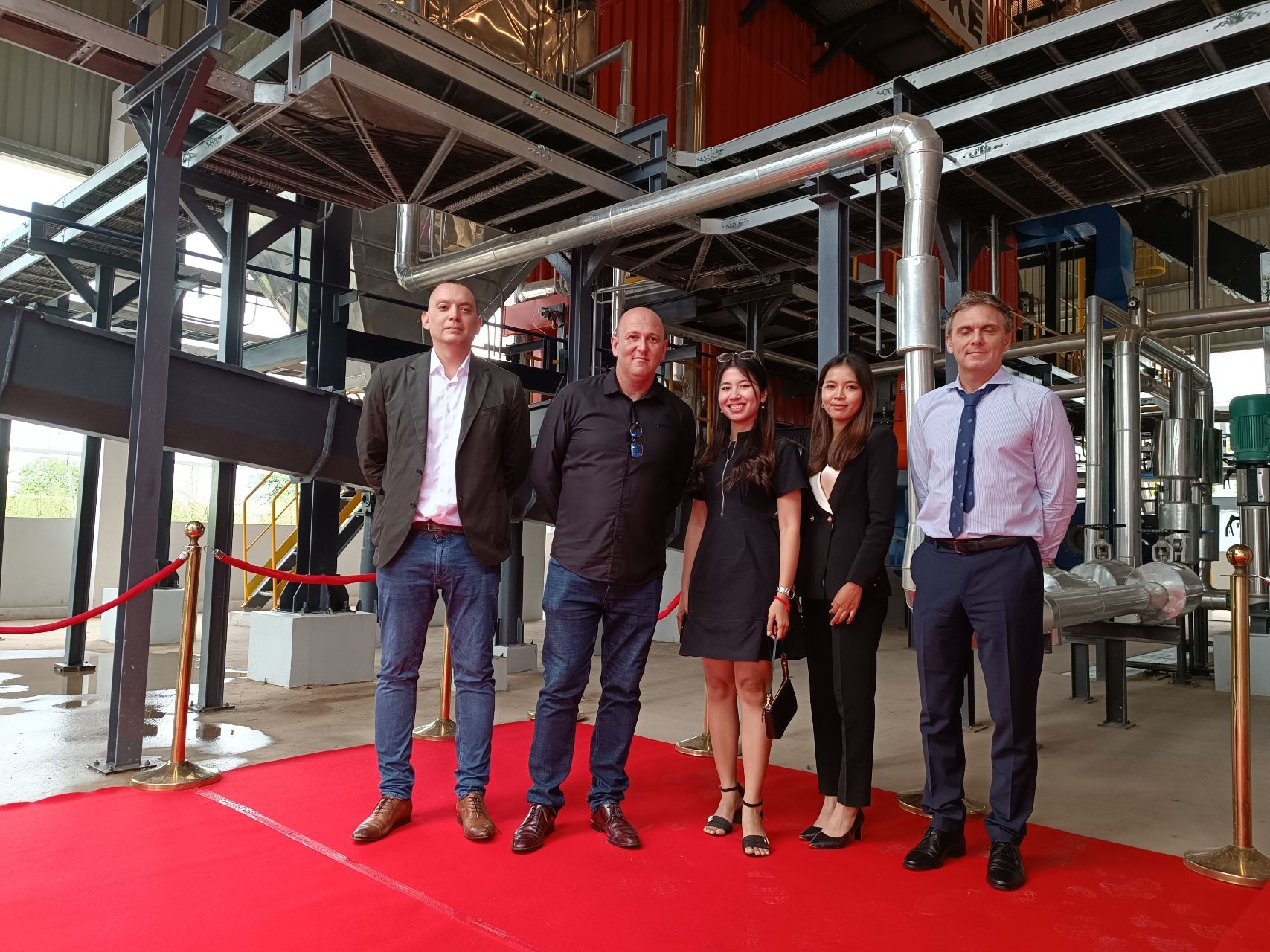
The customer and the site.
Heineken Cambodia operates the Kingdom's leading commercial brewery from a campus on Tiger Beer Street, Roboh Angkanh village, Prek Eng commune, Chbar Ampov district, in southeastern Phnom Penh. Heineken N.V. has been in Cambodia since 1994 — one of the first foreign companies into the market — and the company has invested in expanding production capacity over the years to keep pace with domestic demand and ASEAN export distribution. The brewery itself runs typical brewing thermal loads: mashing, wort boiling, pasteurisation, cleaning-in-place, and packaging — all of which require continuous steam at process pressure.
Before the biomass plant, those thermal loads were met by heavy fuel oil. That made Heineken Cambodia's brewery one of the larger industrial fossil-fuel consumers in the country, and it sat directly in the line of sight of the parent group's net-zero programme. Heineken N.V. has a public commitment to net-zero emissions in production by 2030 and across the full value chain by 2040; reducing fossil fuel use at the largest production sites in the regional portfolio is a material lever toward those targets. By 2021 the Cambodia brewery had already cut its production CO₂ footprint by approximately half versus 2013 through efficiency measures and the introduction of biogas, but the remaining heavy-fuel-oil-dependent thermal load was the obvious next-largest decarbonisation step.
The customer profile was a fit for biomass thermal: a large, continuous steam load with predictable consumption, a parent group with strong sustainability incentives, a willingness to commit to a long-term thermal energy supply agreement, and a site with the land area available within the brewery campus to accommodate boiler, fuel handling, and ash management without disrupting brewing operations. What was less obviously a fit was the country.
Why biomass-as-baseload was harder in Cambodia than it would have been across the border.
Cambodia in 2021 was — and to a significant extent still is — a thinner regulatory and commercial environment for industrial renewable energy than its larger neighbours. There was no equivalent of Vietnam's Decree 80/2024 or 57/2025 DPPA framework. There was no settled wrapper for industrial-scale thermal energy supply agreements with a non-utility provider. The Council for the Development of Cambodia (CDC) administers Qualified Investment Project status, which is the gateway to investment incentives and tax benefits, but the process for a project of this kind — a foreign operator selling thermal energy to a foreign-owned brewery on a long-term contract — was not yet a well-trodden path.
The biomass technology itself was not the blocker. Rice-husk-fired water-tube steam boilers are mature technology, deployed at scale across India, Thailand, and Vietnam since the 2000s. Multiple boiler OEMs were available. The combustion characteristics of rice husk — high silica content, low moisture, high ash, low chloride — are well understood by engineering teams that have done the work before. What was less mature in Cambodia was everything around the boiler.
A biomass plant supplying steam to a brewery on a long-term contract has three things that all have to work simultaneously: (1) a fuel supply chain that delivers consistent specification and tonnage, every day, for fifteen-plus years; (2) a steam offtake commercial structure that gives both parties predictable economics and clear risk allocation; (3) a regulatory and incentive pathway that lets the project clear capital-stack hurdles. None of these were standard issue in Cambodia in 2021. All three had to be assembled.
Three things compounded the structural problem. First, Cambodian rice husk supply is fragmented across hundreds of small and medium-scale rice millers, predominantly in Prey Veng, Takeo, Kampong Cham, Battambang, and Banteay Meanchey provinces. Securing the volume — approximately 45 tonnes per day, every day, year-round — required a multi-source procurement structure that hedged against any single mill failure, harvest variability, or seasonal price spike. Second, the offtake counterparty was not a Cambodian entity but a Heineken subsidiary reporting into Heineken N.V.'s European headquarters; the contract had to satisfy both Cambodian commercial law and the Heineken global procurement and sustainability framework. Third, in the absence of a standard regulatory wrapper, the QIP application and the broader engagement with Cambodian ministries had to be assembled with local advisory partners.
None of these were pure engineering problems. All of them were integration problems — and the project would not commission unless all three were solved simultaneously.
How the deal actually came together.
BECIS Cambodia structured the engagement as a long-term thermal energy supply agreement under which BECIS owns and operates the biomass plant on the Heineken brewery campus and supplies 100% renewable thermal energy at a contracted tariff over the agreement term. Heineken pays for steam delivered, not for the plant — capital risk, fuel price risk, and operational risk sit with BECIS, in line with the standard build-own-operate model BECIS uses across its bioenergy portfolio in Asia. The technical scope was an 11 megawatt-thermal rice-husk-fired water-tube steam boiler with associated fuel handling, ash management, and steam delivery infrastructure connecting into the brewery's existing thermal distribution.
The technical specification
The water-tube design was selected for operating pressure, fuel flexibility, and the ash-handling characteristics suited to high-silica rice husk. Rice husk produces approximately 18–20% ash by mass, with the bulk silica in the form of amorphous silica that can be valorised downstream. That ash stream — and what to do with it — became part of the project design rather than a waste-disposal afterthought (see the circular-economy section below).
The fuel supply chain
The fuel-side architecture was the part of the project that was most country-specific and least transportable from neighbouring markets. Rice husk in Cambodia is produced as a co-product at hundreds of independent rice-mill operations, with limited consolidation and no organised wholesale market for industrial energy use. Securing 45 tonnes per day required a multi-source procurement structure across mills in Prey Veng, the closest major rice-producing province with road logistics into Phnom Penh, supplemented by a wider supplier base across the southern rice belt to absorb seasonal variability and individual mill outages.
Rice mills, Prey Veng
Multi-source procurement from independent millers across the province; supplemented by mills in adjacent provinces to absorb seasonal variability.
Trucked to site
Road haul to the Chbar Ampov plant, with on-site receiving, weighing, and quality acceptance against agreed specification.
Water-tube boiler
Continuous combustion in the rice-husk-fired water-tube boiler producing process steam at brewery delivery pressure.
Steam to brewery
Steam delivered to the Heineken brewery process loop under a long-term contracted tariff. Heineken pays per unit of thermal energy delivered.
Fuel-side risk was the single largest commercial risk on the project. Pricing volatility, harvest seasonality, supplier reliability, transport disruption, and specification drift could each compress the operating margin or — at the edge — interrupt brewery operations. The procurement structure addressed each: long-term framework agreements with anchor mills, agreed specification ranges with quality-acceptance procedures, on-site fuel storage sized for harvest-trough buffering, and a wider supplier panel to spread sourcing risk. Plus the wider strategic point: by buying rice husk at industrial scale, the project created a market for what had largely been waste material, returning value to the rural rice value chain.
Engaging the CDC and the regulatory pathway
The Council for the Development of Cambodia is the primary investment promotion and regulatory coordination body for foreign-invested projects in Cambodia. Securing Qualified Investment Project status was both necessary for the investment incentives that underpinned the project economics and a useful signal of governmental endorsement that smoothed engagement with the Ministry of Mines and Energy and the Ministry of Environment. The QIP application was prepared with Confluences as the local advisory partner and submitted in December 2021, with QIP status granted in February 2022 — approximately three months from filing, a workable timeline by Cambodian standards for a project of this scale and novelty.
Beyond the QIP, the engagement with the Ministry of Environment was material both for environmental approvals during construction and for the public framing of the project as a Cambodian climate-policy success. The plant inauguration in September 2022 was attended by the Minister of Environment and the Heineken Group CEO, alongside CDC and Heineken Cambodia leadership — the kind of multi-stakeholder ceremony that quietly signals that the regulatory pathway has been done correctly and the project sits in good standing with all relevant authorities.
The circular-economy element
The 18–20% ash output from rice-husk combustion is high in amorphous silica and has agronomic value as a soil amendment for rice paddies, which use silica for stem strength and pest resistance. BECIS Cambodia partnered with the Cambodia Institute for Research and Rural Development (CIRD) to channel approximately half of the plant's ash output back into rice farming as natural fertiliser. The arrangement closes a loop — rice husk from rice mills, combusted for thermal energy, ash returned to rice fields — and builds local goodwill around a project whose central commercial purpose is industrial decarbonisation. It is also the kind of rural-engagement signal that matters for sustained licence to operate in a market where industrial projects can come under scrutiny if they are perceived as extractive rather than contributory.
What was harder than it looks
Three things mattered more than the engineering:
- Building a fuel supply chain from a fragmented supplier base in a country with no organised industrial-energy fuel market. The 45 tonnes per day spec is the easy bit; sustaining it across harvest cycles, supplier turnover, and price variability over a fifteen-plus-year contract is what makes or breaks the long-term commercial position.
- Translating Heineken N.V.'s European-headquartered procurement, sustainability, and carbon-accounting standards into a Cambodian commercial structure that was bankable for BECIS. The diligence had to clear Amsterdam, not just Phnom Penh — auditable trail, parent-group approvals, sustainability sourcing certification, alignment with Heineken's published carbon reduction reporting.
- Assembling a regulatory pathway in a market without an off-the-shelf wrapper for industrial thermal energy supply. The QIP framework gave the structure most of what it needed, but the project also had to clear environmental approvals, MME-side coordination, and local-authority engagement in parallel — most of which had no recent precedent for a project of this kind.
What the project delivered, and what it set up after.
At commissioning on 22 September 2022 the project delivered against its three operational targets: 11 MWth installed, supplying 100% of the brewery's thermal energy from biomass, displacing approximately 17,000 tonnes of CO₂ per year — a 60% reduction in production emissions versus the pre-biomass heavy-fuel-oil baseline. Heineken Cambodia progressed a major step against its parent group's 2030 production net-zero target. BECIS Cambodia opened operations on its first project in the Kingdom — the largest biomass plant in the country at the time — and established the country platform on which subsequent BECIS Cambodia projects would build. The fuel supply chain, the QIP, the rural-engagement ash pathway and the brewery offtake all worked from day one.
Beyond the operational numbers, three things mattered more in the longer arc:
- Cambodia got a working precedent for industrial-scale biomass-as-baseload. Until September 2022, biomass in Cambodia had been smaller-scale, predominantly off-grid, and largely tied to single rice-mill cogeneration. The Heineken plant — at 11 MWth, with a long-term offtake to a multinational brewer, with foreign capital and operations behind it — was a template that other industrial decarbonisation projects in the country could point to.
- The project demonstrated that a multinational MNC sustainability commitment could land cleanly in a thinner regulatory environment. Heineken N.V.'s 2030 production net-zero commitment is a global target. Hitting it required local execution in markets ranging from sophisticated Western European utility environments to thinner Southeast Asian frontier markets. Cambodia 2021–2022 was the difficult end of that spectrum. The project showed it was workable.
- The rural rice value chain got an industrial-scale market for what had largely been waste material. 45 tonnes of rice husk per day, every day, paid for at industrial-scale procurement — that's a meaningful new line of income for participating mills in Prey Veng and adjacent provinces. The ash-to-fertiliser loop extended that value back to farmers. Both effects are durable and continue today.
BECIS-era project, operated by BECIS Cambodia today.
The plant has been operating continuously since September 2022 and is operated by BECIS Cambodia under the original long-term thermal energy supply agreement. The customer relationship, fuel procurement, plant operations and maintenance, and Heineken contract management all sit with the BECIS group. BECIS's published case study and ongoing communications cover the project as a BECIS engagement, reflecting who builds, owns, and operates it.
The credibility transfers. The contract doesn't.
The Heineken Cambodia biomass plant and the customer relationship sit with BECIS Cambodia. The plant, the contract, the operations and maintenance, the fuel procurement and the customer-relationship management are all BECIS group's. That is the right outcome — when BECIS structures, builds, and operates a project, the long-tail value sits with BECIS.
Two attribution lines matter equally for this page. The General Manager remit covering BECIS Vietnam and Cambodia sat with Rob Santler (per BECIS public bio at the time). The strategy, the regional leadership, the cross-border MNC playbook, and the institutional engagement with Heineken all flowed from that GM remit. The country delivery — the day-to-day project delivery on the ground in Cambodia — was led by Neil Allen as BECIS Cambodia Country Manager. Without Neil's leadership of the country team, the engagement, ministerial coordination, fuel supply chain build-out, and EPC delivery would not have closed as cleanly as they did. Both attribution lines hold; neither erases the other.
What does transfer to Arcus's advisory work is the operating background. The translation of an MNC-headquartered net-zero commitment into bankable thermal-energy contract structure. The fragmented-supplier-base fuel-chain architecture suited to a thinner industrial-energy market. The QIP-and-Ministry engagement playbook for Cambodia. The Korean / Japanese / European MNC procurement and sustainability-reporting calibration that recurs across the Vietnamese pipeline today. None of that is information sitting on a BECIS server — it sits in the operating fluency that informs Arcus's advisory work.
This page is a track-record case study, not a current Arcus customer reference. Where current Arcus engagements reach commercial close with publishable customer references, those will appear on the case-studies page separately and clearly distinguished from the prior-role record.
Three lessons from Heineken Cambodia that still apply in 2026.
These are the operating heuristics built around the Heineken Cambodia engagement that continue to shape how Arcus approaches industrial renewable energy advisory in 2026, particularly where the engagement involves cross-border MNC offtake, biomass-as-baseload structures, or thinner-market regulatory environments.
1. Biomass-as-baseload is the under-appreciated sibling of solar-plus-storage in Southeast Asian C&I.
Solar PV plus battery storage gets most of the attention in C&I decarbonisation discussions in 2026, and rightly so for sites with daytime-skewed electrical loads and access to a stable grid for evening peak. But for industrial sites where the dominant energy load is process heat — breweries, food processing, textile finishing, paper, pulp, certain chemical processes — solar plus storage doesn't directly displace the fossil-fuel boiler. Biomass thermal does. The Heineken plant's 17,000 tonnes per year of CO₂ avoidance comes from displacing heavy fuel oil at the boiler, not from kWh-side electricity generation. For any industrial decarbonisation conversation that starts with steam load, biomass — given a workable fuel supply chain — is often the first answer, not the last.
2. Fuel supply chain architecture is what makes or breaks long-term biomass economics.
The boiler is the easy part. The 15-year fuel supply chain — pricing structure, supplier diversity, harvest seasonality buffering, quality acceptance, and contractual hedging — is what determines whether the project clears its hurdle rate over the contract life. In Cambodia in 2021 that meant building a multi-source procurement architecture from a fragmented rice-mill base, with rural logistics layered on top. In Vietnam in 2026 the equivalent for a similar project would be a different supplier base — bagasse, rice husk, wood chip, or palm kernel shell depending on geography — but the same architectural principle. Anyone evaluating biomass as a thermal solution should spend most of the diligence time on the fuel chain, not on the boiler.
3. Cross-border MNC sustainability commitments need local execution that can hit headquarters' standards in a thinner regulatory market.
Heineken N.V.'s 2030 production net-zero target was set in Amsterdam. Hitting it required execution in Cambodia. The procurement, sustainability, and carbon-accounting standards that Heineken's central function applies are the same in Phnom Penh as they are in Rotterdam — but the regulatory environment, the supplier base, the contract templates, and the local stakeholder engagement are not. Building the bridge between European MNC standards and a Cambodian commercial reality is most of the work, and it is exactly the work that Korean MNCs, Japanese MNCs, and European MNCs across the Vietnamese pipeline now require for their own decarbonisation commitments. Build to headquarters' standards from the start; expect documentation work to be heavier in thinner markets, not lighter; price the engagement accordingly.